RWA tokenization 2026 market snapshot
The real-world asset (RWA) tokenization market has graduated from experimental pilot programs to a multi-billion-dollar sector. As of late 2025, the total market capitalization for tokenized RWAs (excluding stablecoins) exceeded $36 billion, according to the Canton Network’s 2026 state of the industry report. This rapid expansion signals a structural shift in how traditional finance integrates with blockchain infrastructure.
Tokenized U.S. Treasuries have emerged as the dominant category within this growth. Data from MetaMask indicates that tokenized Treasury holdings alone reached $12.88 billion by early 2026. This specific asset class serves as the primary bridge for institutional capital, offering on-chain liquidity for traditionally illiquid government debt. The concentration in Treasuries highlights a pragmatic approach: institutions are prioritizing yield and regulatory clarity over speculative novelty.
Despite the impressive aggregate numbers, the market remains fragmented. Growth has been uneven across different blockchain networks, with liquidity dispersed rather than consolidated. This fragmentation presents both a challenge for interoperability and an opportunity for specialized infrastructure providers. The trajectory suggests that 2026 will focus less on raw volume growth and more on stabilizing the underlying rails for these assets.
Where the Yield Comes From
The yield in tokenized real-world assets (RWA) is not generated by algorithmic trading strategies or liquidity mining incentives. Instead, it is derived directly from the underlying financial instruments that back the tokens. In 2026, the dominant source of this yield is short-term US government debt, specifically Treasury bills and notes. As the RWA market has matured, institutional capital has flowed into these products to capture risk-free rates in a more accessible, programmable format.
Tokenized Treasuries currently represent the largest segment of the RWA market, with a total value of approximately $12.88 billion. These tokens allow investors to hold fractionalized, on-chain versions of US debt, earning interest that tracks the Federal Reserve’s benchmark rates. This structure provides a stable, predictable income stream that contrasts sharply with the volatile yields often found in traditional decentralized finance (DeFi) protocols. The stability comes from the creditworthiness of the US government, making these assets a preferred vehicle for institutional capital seeking yield without exposure to smart contract risk or crypto-native market volatility.
Beyond Treasuries, money market funds (MMFs) have also begun tokenization. These funds pool capital to invest in high-quality, short-term debt instruments, offering yields that closely mirror the risk-free rate while maintaining high liquidity. The combination of tokenized Treasuries and MMFs has created a robust yield layer for the broader crypto ecosystem, allowing stablecoin issuers and DeFi protocols to offer sustainable returns without relying on speculative lending practices.
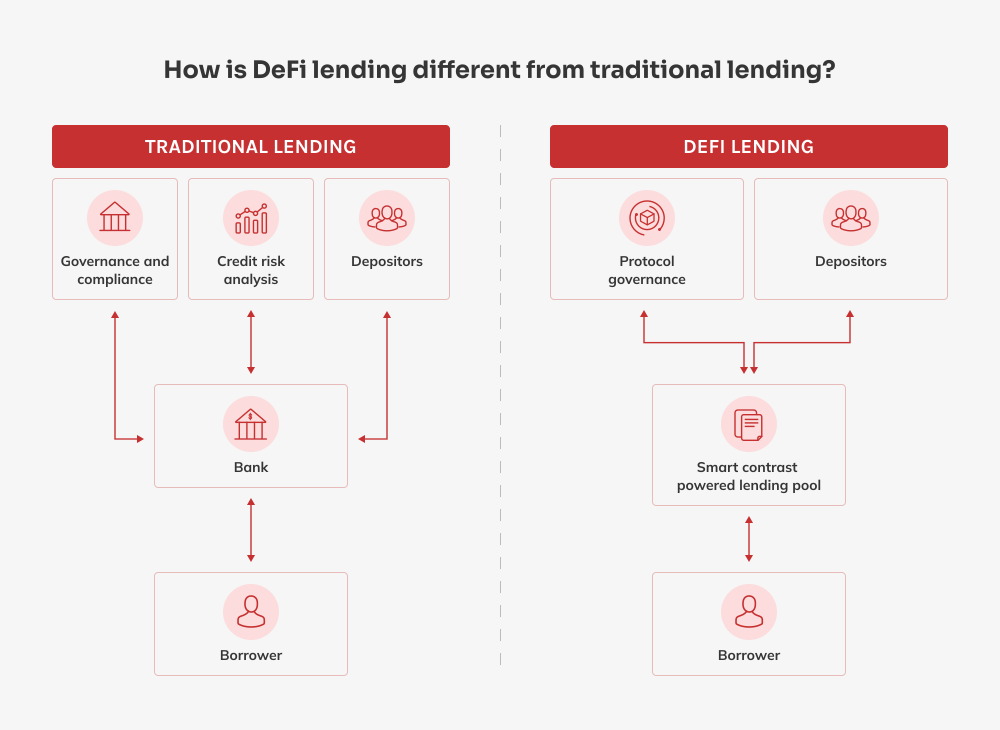
The following table compares the yield profiles and risk characteristics of these primary RWA sources against traditional DeFi strategies.
| Instrument | Yield Source | Risk Level | Liquidity |
|---|---|---|---|
| Tokenized Treasuries | US Treasury Bills | Low (Sovereign) | High (On-chain) |
| Tokenized Money Market Funds | Short-term Commercial Paper | Low (Institutional) | High (T+1) |
| Traditional Stablecoin Lending | Corporate Borrowers | Medium (Credit) | Variable |
| Native DeFi Yield Farming | Trading Fees & Incentives | High (Smart Contract/Market) | High (On-chain) |
Regulatory frameworks shaping 2026
The transition of real-world assets from experimental pilots to standardized financial products is being driven by a wave of new regulatory frameworks. In 2026, the legal ambiguity that once deterred institutional capital is being replaced by clear, enforceable rules. This shift is not merely theoretical; it is actively reshaping the market mechanics of tokenization by reducing compliance costs and legal risk.
In Europe, the Markets in Crypto-Assets (MiCA) regulation has established a comprehensive legal baseline. By defining the operational requirements for asset-referenced tokens and e-money tokens, MiCA provides the regulatory certainty that traditional finance institutions require. This framework forces issuers to adhere to strict capital and governance standards, effectively filtering out speculative projects and leaving room for compliant, high-value asset tokenization.
Meanwhile, the United States is moving through a fragmented but accelerating legislative process. Multiple bills targeting stablecoin issuance and digital asset custody are advancing through congressional committees. These proposals aim to create a federal standard that complements existing state-level money transmitter laws. The goal is to reduce the patchwork of regulatory requirements that currently complicates nationwide RWA deployment.
The convergence of these frameworks is forcing standardization. Issuers are no longer building custom legal wrappers for each jurisdiction but are adopting modular compliance structures that can be deployed across borders. This standardization is critical for scaling the market, as it allows for greater interoperability between different blockchain networks and traditional financial systems.
As these regulations take effect, the RWA market is expected to see a significant reduction in legal friction. This environment will likely accelerate the tokenization of high-value assets such as private credit, real estate, and infrastructure projects, moving the industry closer to the trillions of dollars in potential value projected by major financial institutions.
Leading RWA protocols and platforms
The RWA tokenization market is anchored by established platforms that bridge traditional finance and blockchain infrastructure. These protocols facilitate the issuance, trading, and custody of tokenized assets, with a heavy emphasis on regulatory compliance to meet institutional standards.
Ondo Finance
Ondo Finance has become a primary gateway for tokenized U.S. Treasuries and money market funds. Its flagship product, OUSG, offers exposure to short-term government debt, while USDY provides a yield-bearing stablecoin alternative. The platform operates under strict regulatory frameworks, ensuring that token holders have clear legal claims to the underlying assets. This structure has attracted significant institutional capital seeking on-chain yield with lower volatility than pure crypto assets.
Centrifuge
Centrifuge focuses on real asset financing, connecting borrowers with real-world collateral to DeFi lenders. It enables the tokenization of invoices, real estate, and private credit, allowing these illiquid assets to be used as collateral in decentralized lending markets. By using smart contracts to automate cash flow distributions, Centrifuge provides a transparent mechanism for investors to earn yield from traditional credit markets while maintaining regulatory compliance through its partner structure.
Maple Finance
Maple Finance operates as a decentralized capital market for institutional borrowers. It facilitates undercollateralized lending by vetting borrowers through a decentralized governance system of autonomous treasuries. This model allows institutions to access liquidity without locking up large amounts of crypto collateral, while investors earn yield from high-quality corporate and sovereign debt. The platform’s rigorous due diligence process ensures that only compliant, creditworthy entities can access its capital pools.
RWA tokenization 2026 FAQ
Is RWA tokenization happening?
Yes. The tokenized real-world asset (RWA) market exceeded $36 billion (excluding stablecoins) as of late 2025, with growth accelerating across structured products, money market funds, and tokenized derivatives [[src-serp-1]]. This expansion reflects a structural shift where crypto holders increasingly allocate capital into on-chain representations of traditional financial instruments.
What is the projected valuation of the RWA tokenization market by 2034?
Projections vary significantly based on adoption scenarios. McKinsey estimates the market could reach $2–4 trillion by 2030, while Boston Consulting Group forecasts $16 trillion by the end of the decade. Standard Chartered’s most aggressive model suggests the market could reach $30 trillion by 2034, driven by institutional adoption and regulatory clarity.
What are the primary risks in RWA tokenization?
The main risks include regulatory fragmentation, smart contract vulnerabilities, and liquidity mismatches. While tokenization improves efficiency, it introduces new operational complexities. Investors must assess the legal enforceability of on-chain assets and the reliability of oracle data feeds that link physical assets to blockchain records.
No comments yet. Be the first to share your thoughts!