
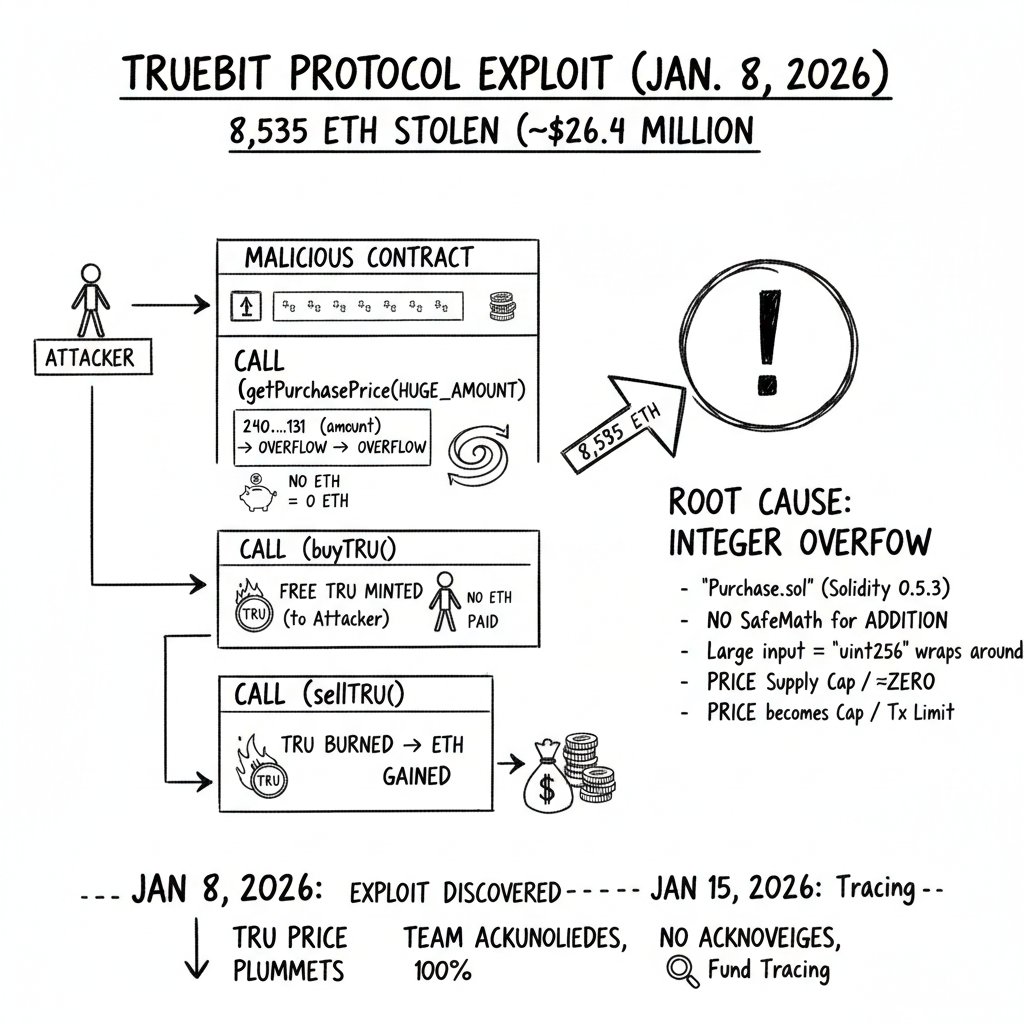
In the fast-evolving world of DeFi, even ancient code can deliver devastating blows. On January 8,2026, the Truebit protocol fell victim to a old smart contract exploits nightmare, losing 8,535 ETH worth about $26.4 million. A sneaky integer overflow in its 'Purchase' smart contract let an attacker mint TRU tokens for pennies and swap them for a fortune, cratering the token's value by nearly 100%. Today, TrueFi (TRU) lingers at $0.009002, a shadow of its former $0.16 self. This wasn't some cutting-edge zero-day; it was a relic from 2021, coded in Solidity 0.5.3 without modern safeguards.
The exploit's simplicity stings the most. Attackers repeatedly bought TRU at zero cost due to flawed math in token pricing logic, draining liquidity pools dry. TRU's 24-hour range barely budged from $0.008918 to $0.009331, underscoring the lasting scar. As someone who's guided clients through depegs and hacks for a decade, I see this as a stark reminder: legacy systems demand vigilance. DeFi's promise hinges on trust in code, yet vulnerabilities like these erode it overnight.

Unraveling the Truebit Hack Mechanics
Truebit's downfall traces to an unchecked arithmetic operation. In older Solidity versions, integer overflows wrap around like an odometer hitting zero, turning small inputs into massive outputs. Here, the 'Purchase' function miscalculated token issuance, enabling infinite minting loops. The attacker laundered the haul swiftly, but the damage rippled: bridge tokens dipped 14%, and TRU holders watched their investments vaporize.
What makes this a textbook Truebit hack insurance case? It exposed dormant flaws in deployed contracts rarely touched post-launch. Quillaudits pinned it on absent overflow checks, a fix available since Solidity 0.8.0. No oracle manipulation or flash loan wizardry; just basic math gone wrong. For DeFi users staking in protocols years old, this screams for proactive DeFi legacy contract coverage.
Critical Lessons to Fortify Against Legacy Exploits
From my client work, I've learned that prevention beats payouts every time. Truebit teaches three pillars:
- Regular Audits and Code Reviews: Even old contracts need fresh eyes. Annual audits catch overflows missed in initial reviews.
- Upgrading Legacy Contracts: Migrate from Solidity 0.5. x to versions with built-in checks. It's disruptive but cheaper than $26.4 million losses.
- SafeMath Libraries: Retrofits like OpenZeppelin's SafeMath add overflow guards without full rewrites.
Yet audits alone falter; Nexus Mutual's post-hack surge showed market faith in insurance amid rising exploits topping $4 billion yearly. My philosophy? Protect first. Dive deeper into exploit mechanics via our case study on major smart contract exploits.
TrueFi (TRU) Price Prediction 2027-2032
Post-Truebit $26M Hack Recovery Scenarios with DeFi Insurance Lessons
| Year | Minimum Price | Average Price | Maximum Price |
|---|---|---|---|
| 2027 | $0.005 | $0.012 | $0.025 |
| 2028 | $0.008 | $0.020 | $0.040 |
| 2029 | $0.010 | $0.030 | $0.060 |
| 2030 | $0.015 | $0.050 | $0.100 |
| 2031 | $0.020 | $0.080 | $0.150 |
| 2032 | $0.030 | $0.120 | $0.200 |
Price Prediction Summary
After the devastating Truebit hack in 2026 that crashed TRU nearly 100% to $0.009, recovery is projected to be gradual. Minimum prices reflect bearish scenarios with lingering distrust; averages assume moderate adoption of fixes and insurance; maximums capture bullish market cycles, enhanced security, and DeFi growth. Year-over-year average growth targets 50-60% in recovery phases.
Key Factors Affecting TrueFi Price
- Implementation of regular audits, SafeMath libraries, and Solidity upgrades to prevent overflows
- Adoption of DeFi insurance protocols like Nexus Mutual and Solace for risk mitigation
- Crypto market cycles, with potential bull runs post-2028 halving driving altcoin recoveries
- Regulatory developments favoring DeFi lending and insurance
- TrueFi's competitive positioning in uncollateralized lending amid improved protocol security
- Broader Ethereum ecosystem growth and reduced exploit risks through legacy contract updates
Disclaimer: Cryptocurrency price predictions are speculative and based on current market analysis. Actual prices may vary significantly due to market volatility, regulatory changes, and other factors. Always do your own research before making investment decisions.
Top DeFi Insurance Shields for Smart Contract Vulnerability Insurance
Insurance isn't a luxury; it's your backstop for smart contract vulnerability insurance. When audits fail and upgrades lag, these protocols step in, covering exploits in both new and old contracts. Ranked by TVL and relevance to legacy risks like Truebit, here are the top five at Defi Coverage:
1. Nexus Mutual: Pioneers in smart contract coverage, they insure against failures like overflows. KYC required, but claims payouts have proven reliable post-hacks. Ideal for Truebit-style math bugs, with pools backing DeFi heavyweights.
2. InsurAce: Focuses on customizable policies for exploits, including legacy vulnerabilities. Their multi-chain support means coverage spans Ethereum relics to newer L2s, with competitive premiums for high-risk pools.
These platforms empower users to hedge without selling assets. As TRU stabilizes around $0.009002, savvy investors are eyeing coverage to reclaim confidence. Explore how these fit your portfolio in our guide to selecting DeFi insurance.
3. Sherlock Protocol: This multi-sig guarded platform pools liquidity for targeted coverage, excelling in smart contract exploits including those in dormant contracts. Users vote on claims, fostering community trust, and its focus on high-profile DeFi apps makes it a solid pick for DeFi legacy contract coverage like Truebit's overflow fiasco.
4. Risk Harbor: Specializes in protocol-specific policies, covering vulnerabilities from arithmetic errors to access controls. With dynamic pricing based on real-time risk assessments, it's nimble for legacy threats, offering quick claims for events mirroring the Truebit drain.
5. Bridge Mutual: Tailored for cross-chain and bridge risks but extends to core smart contract failures. Its community-driven model assesses old exploits rigorously, providing affordable coverage that scales with TVL growth post-incidents like Truebit.
Comparison of Top 5 DeFi Insurance Providers: Coverage for Legacy Smart Contract Exploits
| Provider | Coverage for Legacy Exploits | TVL (Jan 2026) | Claim Speed |
|---|---|---|---|
| Nexus Mutual | ✅ Yes (includes old contracts, KYC required) | $150M | 7-30 days (mutual voting) |
| InsurAce | ✅ Yes (smart contract failures) | $50M | 48 hours |
| Sherlock Protocol | ✅ Yes (vault-based coverage) | $80M | 24-72 hours |
| Risk Harbor | ✅ Yes (DeFi exploits) | $30M | 72 hours |
| Bridge Mutual | ✅ Yes (contracts & bridges) | $40M | 24 hours |
These providers stand out because they explicitly assess and underwrite risks in older contracts, often overlooked by traditional insurers. Nexus Mutual's battle-tested payouts contrast with Sherlock's innovative vaults, while InsurAce and Risk Harbor shine in customization. Bridge Mutual rounds it out for bridge-adjacent legacy code. Check our top DeFi insurance providers roundup for deeper specs.
Why Legacy Exploits Demand Tailored Coverage Now
Truebit's $26.4 million hit, with TRU stuck at $0.009002 after a 99% plunge, highlights how 2021-era code lingers as a ticking bomb. Exploits have siphoned over $4 billion last year alone, many from simple bugs like integer overflows. Insurance bridges this gap, reimbursing losses so you don't have to exit positions prematurely. From my CFP practice, clients using Nexus Mutual or InsurAce slept better during 2026's early chaos, recovering funds while TRU languished between $0.008918 and $0.009331.
But picking the right shield requires diligence. Protocols vary in underwriting: some demand KYC like Nexus, others lean decentralized like Sherlock. Premiums hinge on audited TVL and exploit history, with legacy contracts fetching higher rates due to opacity. Yet, as Truebit showed, the cost of inaction dwarfs any policy fee.
Start by assessing your exposure: which protocols house your assets, and when were they deployed? Tools like Etherscan reveal Solidity versions; anything pre-0.8.0 flags high risk. Then, compare policies via TVL and payout records. Nexus leads in volume, but Sherlock's speed suits urgent needs. Layer coverage across providers for diversification, much like a balanced portfolio.

Real-world resilience comes from blending prevention with protection. Upgrade contracts where possible, deploy SafeMath proxies, and audit relentlessly. But when that's not enough, these insurances activate. Truebit holders, staring at $0.009002 TRU today, wish they'd hedged earlier. At Defi Coverage, we champion Defi Coverage old exploits strategies, empowering you to thrive amid vulnerabilities. Your assets deserve this safeguard; act before the next overflow strikes.




No comments yet. Be the first to share your thoughts!